Richmond has more pre-1930 brick than almost any American city its size. That is most of what makes the Fan, Church Hill, the Museum District and Ginter Park look the way they do — and it is also why hiring the wrong crew to clean brick here can cost you more than every wash that house will ever need.
We clean brick at the lowest pressure that actually works, we test before we commit, and we will tell you when a façade needs a restoration mason instead of a pressure washer.
📞 Call or Text (804) 571-7226 Get a Free Quote Most quotes go out the same day.
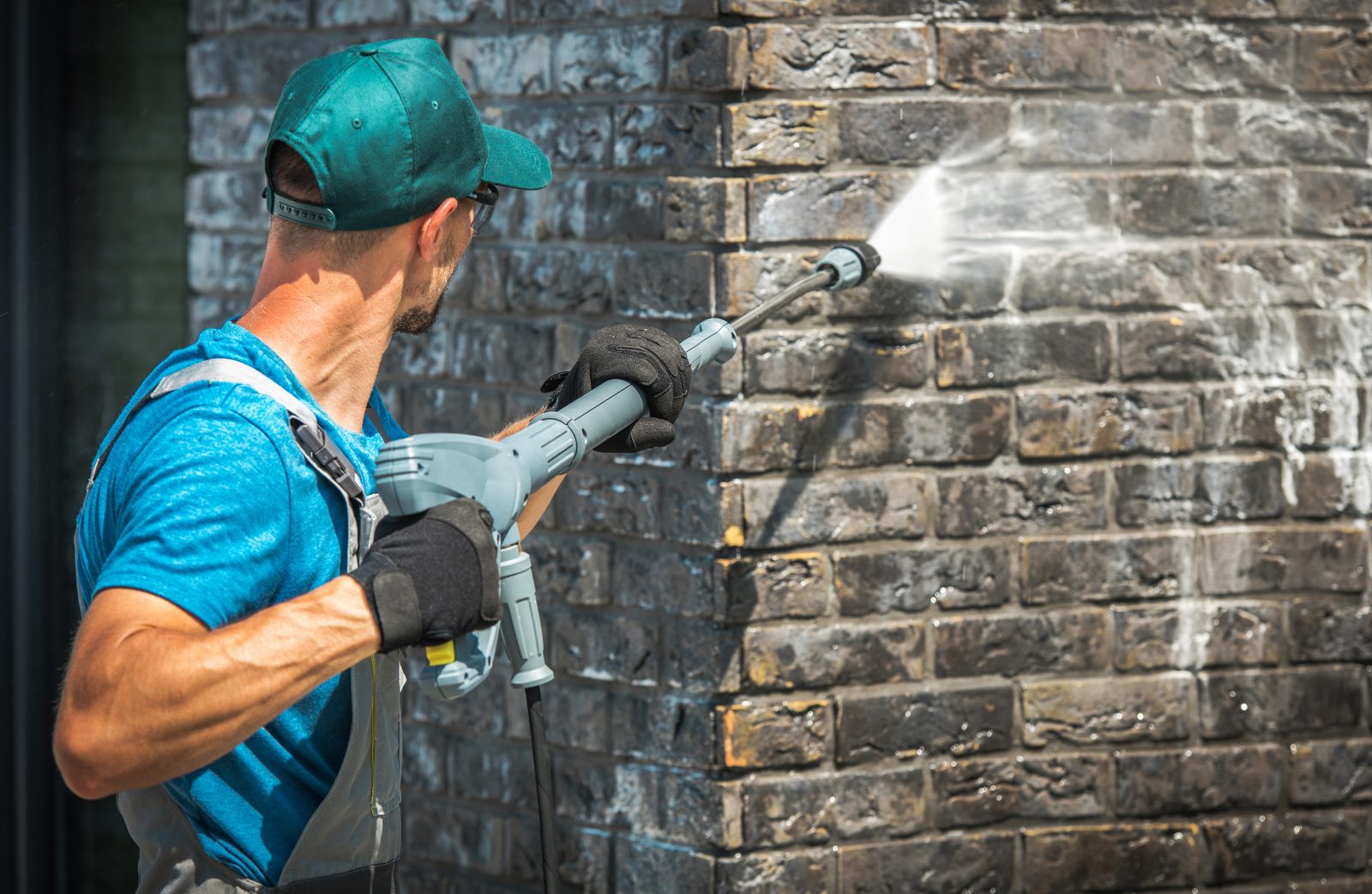
The lime mortar problem
Brick laid before roughly 1930 is bedded in soft lime mortar. That was deliberate, not primitive. Lime mortar is intentionally softer than the brick around it, so that when a wall moves — and every wall moves — the mortar takes the stress and sacrifices itself instead of cracking the brick. It is also vapour-permeable, letting moisture escape through the joints rather than through the face of the brick.
Modern Portland-cement mortar is the opposite: harder than much historic brick, and far less permeable.
Now put 3,000 PSI on a 130-year-old lime joint. You do not clean it — you excavate it. The mortar washes out in a slurry, sometimes an inch deep, and once the joints are open the wall takes on water, spalls the brick faces from the inside during freeze-thaw, and needs repointing. Repointing a Richmond row house façade runs into the thousands. It is the single most expensive mistake in exterior cleaning, and it is made constantly by crews who own a pressure washer and have never been told any of this.
There is a second trap on historic brick. Hand-made and early machine-made brick was fired with a harder, denser outer layer — the fire skin — protecting a softer core. Strip that skin off with abrasive blasting or excessive pressure and the brick begins absorbing water and decaying permanently. It cannot be put back.
How we approach it instead
- We identify what we are dealing with first. Age of the building, mortar type, condition of the joints, whether the brick has been painted or previously sandblasted.
- We test an inconspicuous section. Usually a rear or side elevation, low down. We start at the gentlest setting and step up only as far as needed.
- We use the lowest effective pressure. On sound historic masonry that often means soft-wash range — detergent doing the work, water only rinsing.
- We work with dwell time, not force. Letting a cleaning solution sit and do its job is almost always the answer where a homeowner expects more pressure to be.
- We stop and say so when the honest answer is that the wall needs a mason, not a wash.
What we remove from brick
- Green algae and black biological growth, worst on shaded and north-facing elevations
- General atmospheric grime and traffic soot
- Mildew on painted brick
- Clay splash and the orange staining at the water table
- The dark shadowing that collects under eaves and along the base of a wall
- Cobwebs, mud dauber nests and organic debris in mortar joints
Efflorescence — the white bloom
If your brick has a chalky white haze, that is efflorescence: soluble salts inside the masonry dissolving in moisture, migrating to the surface and crystallising as the water evaporates.
It cleans off readily. The honest part is what happens next. Efflorescence is a symptom — it means water is moving through the wall. Wash it away without addressing the water and it returns, often within a season. Common sources in Richmond homes are failed gutters and downspouts dumping against the wall, grade sloping toward the foundation, a missing or bridged damp-proof course, and sprinkler heads aimed at the brick.
We will clean it, and we will tell you where we think the water is coming from. Fixing that is usually a different trade, and we would rather you hear it from us than pay us twice.
Painted brick
Painted brick is everywhere in Richmond, and it is far more delicate than it looks. Paint on masonry fails from behind — moisture trapped in the wall pushes it off — so by the time you can see chalking or hairline flaking, adhesion is already gone across a wider area than is visible.
Wash a wall in that condition and paint will come off with the dirt. Not because the wash was too aggressive, but because it was only ever held on by habit. We inspect painted brick carefully first and tell you plainly what will happen.
What we will not do
- No sandblasting. Ever. It destroys the fire skin, permanently accelerates decay, and on a historic building it is straightforwardly vandalism.
- No high pressure on lime mortar. See above.
- No muriatic acid as a default. Acid has legitimate uses in masonry cleaning, in the right dilution, on the right substrate, with proper neutralisation. It is not a first move.
- No pretending a structural problem is a cleaning problem. Open joints, stepped cracking, spalling faces and bulging walls need a mason.
Richmond brick, by era
Almost every question about cleaning brick here comes down to one thing: when was it laid, and what is holding it together. Richmond has roughly four generations of masonry sitting within a few miles of each other, and they do not want the same treatment.
- Pre-1880 — Church Hill, Shockoe, parts of Jackson Ward. Soft, hand-made brick with soft lime mortar. The brick itself is often softer than the mortar joint. This is the masonry that gets destroyed by pressure washing, and it is the reason we treat any pre-1900 building as chemical-only until proven otherwise.
- 1890–1930 — the Fan, Museum District, Northside. Machine-pressed brick with a harder face, still commonly on lime or lime-cement mortar. Better wearing than the older stock, but the joints remain the weak point.
- Warehouse and industrial — Shockoe Bottom, Scott’s Addition, Manchester. Hard-fired structural brick, often with a century of atmospheric soiling. Tougher than it looks, but frequently carries paint, tar and old signage that need very different handling from dirt.
- Post-war veneer — Henrico, Chesterfield, Bon Air, Lakeside. Modern kiln-fired brick on Portland cement mortar. Durable, forgiving, and the easiest of the four to clean well.
- Contemporary veneer — Short Pump, Glen Allen, Wyndham. The same as above but newer, and the most likely to show efflorescence rather than soiling, because the mortar is still curing.
The masonry wash, step by step
- 1. Identify the mortar. A lime joint and a Portland joint look similar from ten feet and behave completely differently. We test rather than assume, in a spot nobody will look at.
- 2. Test panel first. A small area, cleaned to the settings we intend to use, left for you to look at. On historic work this is not optional.
- 3. Wet the wall down. Saturating the masonry first stops the cleaner being pulled deep into the brick and mortar, which is what causes staining and mortar damage later.
- 4. Apply the appropriate cleaner and let it dwell. The chemistry does the work at low pressure. Dwell time, not force, is what removes a hundred years of soiling.
- 5. Rinse thoroughly, top-down, at low pressure. Under-rinsing is what leaves brick looking blotchy weeks later as residue migrates back to the surface.
What you are actually looking at
- Green or black film, worst on the north face. Algae and mildew. The most common complaint and the easiest to fix.
- A white powdery bloom. Efflorescence — salts moving out of the masonry with moisture. Cleaning removes what is on the surface, but recurring bloom means water is getting in somewhere.
- Dark gray-black crust in sheltered areas. Atmospheric soiling, common on older city buildings, and the change after cleaning is dramatic.
- Rust-brown streaks below sills and anchors. Iron staining from embedded metal. Needs a specific treatment, and it will return if the source is still corroding.
- Sandy mortar you can rub loose with a thumb. Failing joints. Stop — this is a repointing job, not a cleaning job, and washing it will make it worse.
Working on designated historic properties
Richmond has a number of Old and Historic Districts, and exterior work on designated properties can require review before it starts. Cleaning is often routine maintenance, but treatments that would change appearance — paint removal in particular — are the kind of thing that draws scrutiny. If your property is in a designated district, check with the city before committing to any approach, and be wary of any contractor who tells you not to bother. We are happy to work to a specified method.
What brick cleaning costs in Richmond
Modern brick veneer on a typical home usually falls between $300 and $600, and is often bundled into a house wash. Historic and multi-story masonry is quoted per building after a look, because the variables are too wide for a list. What drives it:
- Age and mortar type — soft lime mortar means slower, gentler, more careful work.
- What is on the wall — algae rinses; atmospheric crust, iron staining and old paint do not.
- Height and access — three-story city rowhouses need different reach than a suburban veneer ranch.
- Test panel and approvals — historic work carries more up-front time before any production cleaning happens.
- Condition of the joints — if repointing is needed first, cleaning waits.
Residential ranges are on the pricing page. If your brick is modern veneer, the house washing page covers how it fits into a full exterior wash.
Related reading
If you are seeing a white bloom rather than green growth, read white powder on brick and concrete — it is a different problem with a different cause. Method differences are covered in soft washing vs pressure washing.
Common questions
How do I know whether my mortar is lime or Portland?
Age is the first clue — broadly, pre-1900 is likely lime and post-war is almost certainly Portland. But the reliable answer is a test in an inconspicuous spot. Lime mortar is softer, lighter, and gives under a pick where Portland resists. We check before we plan anything.
Can you clean brick without touching the mortar?
Not literally, but that is the goal. The whole approach — saturating first, low pressure, chemistry doing the work — exists to leave joints exactly as we found them. Pressure washing is what erodes mortar, and we do not use it on masonry.
Will you remove paint from brick?
Sometimes, and cautiously. Paint removal from soft historic brick can pull the fired face off with it, which is permanent. We test, we show you the result, and on a designated property we tell you to get approval first.
Is my brick veneer the same as historic brick?
No, and it is good news. Modern veneer on Portland mortar is harder, less absorbent and far more forgiving. Most Henrico and Chesterfield homes fall into this category and clean up straightforwardly.
Do you work in the historic districts?
Yes, and carefully. We work to specified methods, we test first, and we would rather you have approval in hand than find out afterward it was needed.
What causes the white bloom, and will it come back?
Efflorescence is mineral salt carried to the surface by moisture moving through the masonry. We can remove what has surfaced. Whether it returns depends on whether the water source is still there — a leaking gutter, failed flashing, or simply new mortar still curing.
My brick looks fine but the house smells musty inside. Related?
Possibly. Persistent damp masonry, blocked weep holes, or grade built up above the damp course can all show up as an indoor smell. That is outside what we do, but we will tell you what we notice on the wall.
Can you clean brick in winter?
Not below freezing. Water in masonry that freezes causes spalling, and no result is worth that. We work brick from roughly March through November here, and we will reschedule rather than risk it on a marginal day.
What about the brick chimney?
Same approach, more access planning. Chimneys are also where we most often spot failing crowns and flashing, and we will mention it if we see it.
Should brick be sealed after cleaning?
Usually not. Breathable masonry needs to release moisture, and the wrong sealer traps it and causes spalling. There are situations where a vapor-permeable treatment makes sense, but the default answer is leave it alone.
📞 Call or Text (804) 571-7226 Get a Free Quote Most quotes go out the same day.