Most people assume their concrete has just aged. Then we run a test strip across it, and the difference between the clean line and everything around it is usually a shock.
Your driveway is not gray. It is dirty.
📞 Call or Text (804) 571-7226 Get a Free Quote Most quotes go out the same day.
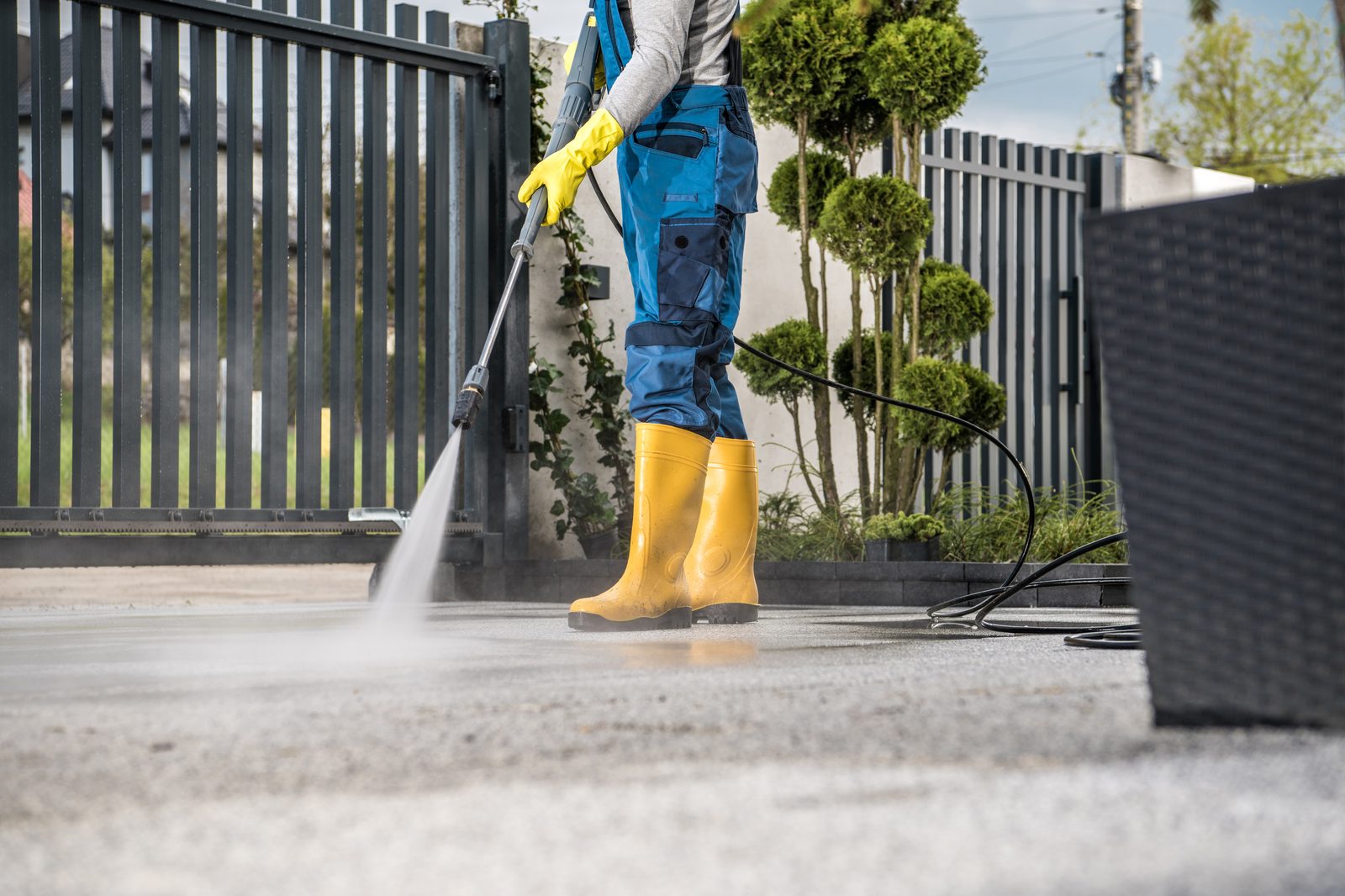
Your concrete is not gray, it is dirty
Concrete is porous. Every pore holds moisture, and in Richmond’s climate that means every pore eventually holds something living — algae, mold and mildew, spread evenly enough across the whole slab that it reads as color rather than as growth. Layer on tire rubber, engine drips, leaf tannin, pollen and clay and the surface darkens a shade a year, slowly enough that nobody notices.
That is why the test strip is so persuasive. One pass with a surface cleaner and the original concrete appears, several shades lighter, and suddenly the rest of the driveway looks like what it actually is.
What we clean
Driveways · walkways and paths · front steps · patios · pool decks and surrounds · curbs and aprons · garage floors · retaining walls · basement stairwells and areaways · brick and paver walkways
The winter salt line
This is the Richmond-specific problem the national pricing pages never mention.
From December through March, VDOT and the counties treat the roads with salt brine and cinder grit. It gets tracked up your driveway on four tires, every trip, all winter. Then it sits — through the freeze-thaw cycles that make it worst, and into a spring where nobody is thinking about the driveway yet.
Salt residue leaves a pale, patchy crust, usually heaviest in the first ten feet from the street and around where you park. Worse, chloride works into the pores and accelerates surface scaling: that fine pitting and flaking that makes older Richmond driveways look tired well before they are structurally done.
It does not respond well to pressure alone. Salt needs to be chemically broken down and flushed, which means a pre-treatment and dwell time before the surface cleaner ever touches it. Spring is the right time to deal with it.
Piedmont clay staining
Richmond sits on iron-rich orange clay, and it gets everywhere: splashed onto the apron in hard storms, tracked from garden beds, washed down from a slope after heavy rain.
Clay is a pigment problem, not a dirt problem. Hit it with pressure and you smear it deeper into the pores — which is why so many DIY attempts leave an orange ghost. It needs an acidic or chelating pre-treatment to break the iron bond, then flushing. Fresh staining usually comes out completely. Staining baked in over several summers often lightens dramatically rather than disappearing, and we will set that expectation at the quote.
Oil, rust, tire marks and battery acid — the honest version
- Fresh oil and transmission drips — usually come out fully with a degreaser and dwell time.
- Old, deeply soaked oil — lightens substantially. A shadow often remains. Anyone promising total removal from a ten-year-old stain is guessing.
- Rust from patio furniture, rebar or fertiliser — needs specialist chemistry, not pressure. Often removes well, sometimes leaves a faint halo.
- Tire marks and scuffing — generally clean up well.
- Battery acid and paint — acid etches the concrete surface itself; that is damage, not dirt, and it does not wash out.
We would rather lose a job by being straight about this than get a call afterward about a stain we implied would vanish.
Why a surface cleaner beats a wand
Cleaning a driveway with a handheld wand is how you get a zebra-striped driveway: alternating light and dark bands where passes overlapped or did not. Once it is there, the only fix is doing the whole slab again properly.
A rotary surface cleaner runs two jets on a spinning bar inside a shrouded housing, at a fixed height and consistent overlap. The result is even edge to edge, with no striping and far less overspray onto siding and beds. Around the perimeter and in tight spots we finish by hand.
If you are comparing quotes, ask what they are cleaning with. It is the single best predictor of how the driveway will look afterward.
Should you seal it?
Sometimes. Sealing after cleaning slows staining, reduces water absorption and helps against freeze-thaw scaling — genuinely useful on Richmond’s winter cycle. It is worth it if your concrete is in decent shape, gets salt exposure, and you would rather clean it less often. It is not worth it if the surface is already scaling badly, since sealer over a failing surface just locks the problem in.
The 5-Step Concrete Clean
- 1. Clear and inspect. Everything movable comes off the slab. We note oil, rust, paint, existing sealer, and any cracking or spalling before water touches it, so nothing gets blamed on us afterward.
- 2. Pre-treat the stains that need it. Oil, rust and organic growth each need a different chemistry. Applying one product to all three is how you end up with a clean driveway that still has a dark patch where the car sits.
- 3. Surface-clean in overlapping passes. A rotary surface cleaner covers the slab at an even distance and consistent pressure. This is the step that produces a uniform result instead of a zebra-striped one.
- 4. Detail the edges and joints. A surface cleaner cannot reach the perimeter, control joints, or the apron against the garage. Those get wanded by hand, which is the slow part.
- 5. Post-treat and rinse. A final rinse carries the loosened soil off the slab rather than leaving it to dry in place, and any remaining organic growth gets a treatment so it does not return in six weeks.
Signs your driveway is overdue
- A clean rectangle where something has been sitting. The trash can or planter did not bleach the concrete — everything around it got dirty.
- Green or black film along the shaded edge. Algae, and it is slick underfoot when wet.
- Orange or rust-brown bleed near beds and downspouts. Piedmont clay and iron in the runoff.
- A white chalky bloom on pavers or a newer slab. Efflorescence — mineral salts moving to the surface, not dirt.
- A dark halo under the car. Oil that has penetrated. Catch it early; it gets harder every year.
- Black tire scuffs that will not sweep off. Rubber transfer, which needs a solvent rather than pressure.
What else we clean while we are there
The driveway is usually the reason for the call, but the crew and equipment are already on site, and these cost far less bundled than booked separately:
- Front walkway and steps — the surface every visitor actually looks at.
- Back patio and pool deck — where algae film is a genuine slip hazard.
- Curb apron and sidewalk frontage — the strip that makes the whole property read as maintained.
- Garage floor — same equipment, and it comes up better than most people expect.
- Retaining walls and paver edging — usually the greenest concrete on the property.
What driveway cleaning costs in Richmond
Most residential driveways fall between $150 and $350. Larger or heavily stained drives run higher, and bundling walkways or a patio adds less than doing them separately. What moves the number:
- Square footage — a two-car apron and a long shared drive are very different jobs.
- Surface type — broom-finish concrete, exposed aggregate, stamped concrete and pavers each clean at different speeds.
- Stain load — oil, rust and heavy organic growth all need pre-treatment, and pre-treatment is time.
- Slope and drainage — where the water goes affects how much containment and rinsing the job needs.
- Sealer — if you want it sealed afterward, that is a separate day once the slab is fully dry.
Everything we charge is on the Richmond pricing page. Concrete is the one surface where high pressure is appropriate — see soft washing vs pressure washing for why siding is the opposite.
Related reading
White bloom on pavers or a newer slab? That is efflorescence, not dirt. And concrete is the one surface where real pressure is right — here is why siding is the opposite.
Common questions
What pressure do you use on concrete?
Real pressure, unlike siding. Concrete is one of the few surfaces that genuinely wants it, delivered through a surface cleaner so it lands evenly rather than in stripes.
Will it remove paint splatter?
Sometimes. Fresh latex often lifts. Cured paint, especially oil-based, usually needs a solvent and even then does not always come off cleanly. We will test a spot and tell you honestly before charging you for it.
How long before I can park on it again?
As soon as it is dry to the touch, usually an hour or two in summer and longer in cool weather. If we sealed it, that is a different answer and we will give you a specific one.
Are pavers and stamped concrete safe?
Yes, with adjusted settings. Pavers need care around joint sand, which we re-sand if the wash displaces it. Stamped concrete usually has a decorative sealer, so we clean at a pressure that will not strip it.
How often should a Richmond driveway be cleaned?
Every one to two years for most homes. Shaded drives under a mature canopy need it annually. If you can see the shaded half is darker than the sunny half, it is time.
Can you get the oil stain out completely?
Often mostly, rarely entirely. It depends on how long it has been there and how porous the concrete is. Fresh oil comes up well. A ten-year drip under a parked car has soaked in below the surface and will lighten rather than vanish.
What about the rust stains from my irrigation?
Those respond to a rust-specific treatment, not pressure. Iron in well and irrigation water is common here, and it will come back unless the sprinkler head is redirected. We will point out which head is doing it.
Do you re-sand paver joints?
Yes, when the wash displaces sand, which it usually does to some degree. It is part of doing the job properly rather than an upsell.
Should I seal the driveway afterward?
On pavers and stamped concrete, usually yes — it protects the surface and holds joint sand. On plain broom-finish concrete it is optional and mostly cosmetic. Either way it happens on a separate visit once the slab is fully dry.
Will the runoff hurt my lawn or beds?
No. The beds get soaked before we start and rinsed after, and the detergent volume reaching them is small and diluted. The grass along a driveway edge is the most common casualty of crews who skip that step, so we do not skip it.
📞 Call or Text (804) 571-7226 Get a Free Quote Most quotes go out the same day.